

Why Do High-Speed Crashes on Chicago Expressways Lead to Catastrophic Injuries?
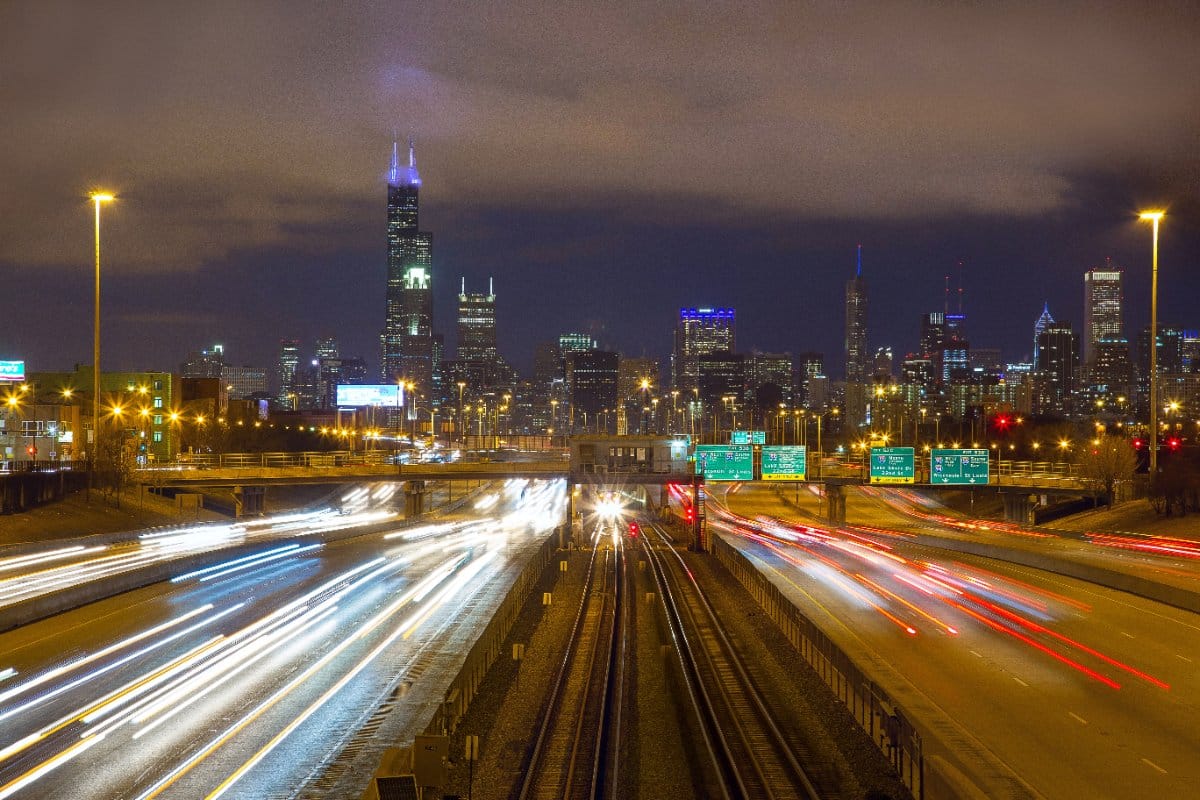 Physics helps explain the connection between high-speed car accidents in Chicago and catastrophic injuries. As a vehicle’s speed increases, so does the crash energy, with kinetic energy increasing with the square of speed.
As the city’s Department of Transportation indicates, vehicle speed is the top factor deciding if a crash occurs and how severe the injuries are. Pedestrians hit by a vehicle traveling 30 mph are twice as likely to be killed as those hit by a vehicle going 25 mph. That’s “just” a 5 mph speed difference, highlighting the seriousness of sharply increasing crash energy. Human bodies can’t absorb car crash-type violence without undergoing serious damage.
Trucks are another part of the equation. They’re big and fast, and you’re more likely to find them on expressways than on neighborhood streets. Expressway traffic is unpredictable, too. Drivers may be going a smooth 60 mph one moment, only to brake abruptly a few seconds later to a much slower 20 mph. Dangerous traffic patterns in Illinois are common on the Dan Ryan near downtown, the Stevenson near Midway International Airport, the Eisenhower Expressway between Chicago and Oak Park, and many other places.
The physics behind Chicago’s high-speed expressway catastrophic crashes
As vehicle speed increases, it carries more kinetic energy that has to go somewhere. When a crash occurs, much of that energy transfers directly into the occupants of the receiving vehicle(s). As the Chicago DOT notes, 67% of the city’s traffic fatalities from 2019 to 2023 involved high speeds.
Moreover, 43% of the 1,753 crash deaths in Cook County between 2018 and 2022 involved speeding. For comparison, 36% involved cellphone use, and 34% involved occupants who did not have seatbelts on. These categories may involve overlapping crashes, but the point is that high speeds are risky and possibly more dangerous than distracted driving.
The violent force of a high-speed crash is serious. While newer cars are safer in the sense that seatbelts, airbags, and stronger vehicle frames save lives every day, these newer vehicles still cannot absorb 100% of crash forces and prevent all injuries.
Why are injury risks higher at greater speeds?
Greater speeds pose many dangers throughout Chicago, including on the expressways. Examples include:
- More violent force of impact
- Less time for drivers to react or stop
- Higher chance of rollovers and multicar pileups
- More chance of occupants being thrown from vehicles
The smaller the crash impact, the more likely an injury is minor. The more violent the impact, the higher the chance of catastrophic injuries.
Traumatic brain injuries are one serious potential outcome of a high-speed car accident in Chicago. The brain strikes the inside of the skull or moves violently due to major rotation, acceleration, or deceleration forces. The head does not have to hit anything for TBI to result.
Spinal cord injuries are another type of catastrophic injury. They may occur during crashes, rollovers, and high-speed impacts on expressways.
Why are multiple impacts from high-speed crashes dangerous?
At high speeds, you may experience an initial impact and then subsequent impacts that could be even more serious. For example, a car that is rear-ended by a tractor-trailer may strike another car. Due to both impacts, occupants in the first car may sustain injuries from seat belts, airbags, windows, and doors. Each impact increases the risk of catastrophic injury.
On Chicago’s expressways with their heavy traffic, multiple impacts or secondary impacts are relatively common in crashes. A wreck on the Dan Ryan, Kennedy, or Eisenhower may not involve just one impact.
Even with just one impact, high-speed expressway crashes can result in multiple types of catastrophic injuries at once. Victims could experience any combination of TBI, spinal cord damage, fractures (including broken facial bones), internal bleeding, and organ damage. In many cases, the damage lasts for years, if not a lifetime, and requires extensive treatment and rehabilitation.
Victims of catastrophic injuries often deal with huge medical bills, long hospitalizations, long rehabilitation timeframes, surgeries, the need for home modifications, job losses, nursing care, pain and suffering, and much more. Chicago car crash lawyers can help you explore compensation options.
Why do trucks increase crash forces and the chances of catastrophic injuries?
The large trucks traveling every day on I-90, I-94, I-55, and the other Chicago-area expressways bring more force to a crash and increase injury severity. The tremendous weight of a tractor-trailer increases the force of a crash, and trucks have a harder time slowing down or stopping than cars do.
As the Insurance Institute for Highway Safety explains, when a truck crashes, most of the deaths that result are among the occupants of passenger vehicles. Since Chicago is a major freight hub, trucks are always traveling on its interstates and expressways. Cars must share expressway space with these vehicles that are 20 to 30 times heavier.
When a high-speed car accident in Chicago involves large trucks or other commercial parties, a high level of investigation may be needed to properly identify all liable parties. For instance, the trucking company may share some blame, and so could other parties such as the cargo loader.
What is a high-speed crash on a Chicago expressway?
This is subjective, but you can generally consider expressway speeds of 55 mph or more as high-speed. On a residential street with a 30 mph limit, high speed may mean 40 mph.
Unfortunately, the crash energy of a vehicle traveling at 55 mph is significantly more violent than the force the same vehicle would generate traveling just 10 mph less, at 45 mph.
Learn about your compensation options as soon as possible
High-speed car accidents in Chicago can be devastating and change your life in one second. It’s important to protect your rights. If you or someone you love has been injured in an accident on Chicago roadways, reach out to Gainsberg Injury and Accident Lawyers to discuss your options. Please contact us today.

Attorney Neal Gainsberg has spent the last 20+ years fighting to protect the rights of the injured in Chicago and throughout Illinois. For dedicated legal help with a personal injury, car accident, or wrongful death matter, contact Gainsberg Injury and Accident Lawyers in Chicago for a free consultation.